
Survival Instead of Extinction: First Nations Rally to Save Wild Salmon on Coastal British Columbia
Traditional knowledge and Western science, backed by direct action, helped First Nations reclaim ancestral waters from industrial salmon farming and rebuild wild abundance
When the Transformer, Ḵaniḵiʼlakw, travelled around the world, he was eventually returned to the place where Gwaʼnalalis lived. In an earlier encounter, the Transformer had beaten Gwaʼnalalis, who was ready for his return. Ḵaniḵiʼlakw asked, “Would you like to become a cedar tree?” Gwaʼnalalis replied, “No, cedar trees, when struck by lightning, split and fall. Then they rot away for as long as the days dawn in the world.” Ḵaniḵiʼlakw asked again, “Would you like to become a mountain?” “No,” Gwaʼnalalis answered, “For mountains have slides and crumble away for as long as the days dawn in the world.” The Transformer asked a third question. “Would you like to become a large boulder?” Again, Gwaʼnalalis answered, “No. Do not let me become a boulder, for I may crack in half and crumble away as long as the days dawn in the world.” Finally, Ḵaniḵiʼlakw asked, “Would you like to become a river?” “Yes, let me become a river that I may flow for as long as the days shall dawn in the world,” Gwaʼnalalis replied. Putting his hand on Gwaʼnalalis’ forehead and pushing him down prone, Ḵaniḵiʼlakw said, “There, friend, you will be a river and many kinds of salmon will come to you to provide food for your descendants for as long as the days shall dawn in the world.” And so the man Gwaʼnalalis became the river, Gwaʼni.
The Transformer then took all the shellfish from the river and threw it to the neighbouring islands, and said, “Your people will have such an abundance of salmon that you will have no need for other resources on this river, those people on the islands will come here to trade for your salmon.”
—Origin story of the ‘Na̱mg̱is
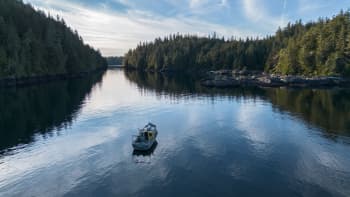
For the multinational firms that dominate the global salmon market, these iconic fish are domesticated livestock, the raw material for a lucrative global industry.
Consumers—mostly well-heeled ones in the United States, Europe, and China—bought USD 20 billion worth of farmed salmon in 2025. Global salmon sales are expected to surge 75 percent within a decade, according to the research firm Business Research Insights.
But for many Indigenous Peoples, including those who live on the northwestern coast of North America, salmon aren’t commodities to be produced with factory-like efficiency to maximize returns for shareholders, or pink fillets gleaming in a supermarket cold display, promising to deliver concentrated nutrition to those who can afford it. They’re a revered wild species, an ecological linchpin, and a dietary staple.
“We were born from this land, we are part of the soil, we are part of the sea... and saving the salmon means saving our connection to the land and the water and everything around us—the forest, the bears—everything that is in our lands, in our seas.”
—Rick Johnson
Elected Chief Councillor and a Hereditary Chief of the Ḵwiḵwa̱sut’inux̱w Ha̱xwa’mis First Nation.
These two visions of salmon—farmed vs. wild, commodity vs. cultural treasure—have clashed on British Columbia’s Broughton Archipelago, Canada’s westernmost edge, since the late 1980s, when open net-pen salmon aquaculture operations began to alight upon the site of some of the world’s last robust wild salmon runs. For most of the time since, the industrial vision has persisted, threatening to render wild salmon an anguished cultural memory. But over the past decade, through Indigenous movement-building, direct action, and a boost from environmental NGOs, the Mama̱liliḵulla, ‘Na̱mg̱is, and Ḵwiḵwa̱sut’inux̱w Ha̱xwa’mis First Nations have organized to reclaim their ancestral waters for wild salmon, requiring closures of aquaculture farms in their traditional waters. They have done so through a strategic and organized process, bridging industry, policy, science, and tradition to collectively recognize and respect the real value of wild salmon. The trigger was a direct conversation among the Mama̱liliḵulla, ‘Na̱mg̱is, and Ḵwiḵwa̱sut’inux̱w Ha̱xwa’mis First Nations, the provincial BC government, and the salmon-farming industry, in which Indigenous Peoples were respected as authorities.
Wild salmon aren’t likely candidates to thrive under the regimentation and confinement of a factory farm.
They hatch far up freshwater streams, often hundreds of miles from the shore. They migrate to the ocean, where they range over additional hundreds and even thousands of miles, developing fatty, pink-hued flesh from gobbling up krill and shrimp. Then, displaying a geospatial dexterity that Western science has not been able to explain, they swim upstream, against fierce currents and daunting elevation, back to their original birthplace to spawn the next generation. On the northern reaches of both coasts of present-day North America, these cold-water fish thrived for millennia alongside Indigenous Peoples. Since colonization, most U.S. and Canadian wild salmon runs have come under extreme pressure—if not outright extinction—from pollution, dams, excessive fishing (in some cases), and/or the impacts of intensive aquaculture. But because the Broughton Archipelago is a network of islands separate from mainland Canada, its rivers were never waylaid by dams or nearly as harmed by industrial pollution. So its salmon runs mostly flourished—until aquaculture operations started to impose their presence on this region in the late 1980s.
Born in 1958, Don Svanvik, a Hereditary Chief of the ‘Na̱mg̱is, one of the First Nations in present-day British Columbia, grew up in a time of abundance. “We are salmon people—salmon is in our DNA,” he says. “When I was a young child in my grandparents’ house, there was dried fish hanging in the kitchen for six months of the year. All you did was reach up and grab a piece.” Preserving it kept the smokehouse running all summer into the fall, he adds. Such abundance continued into his adulthood in the early 1980s, when sockeye salmon, the tribe’s most prized species, was a pillar of life for his young family. “For my wife, and my two children, we would normally have about 100 to 150 sockeye a year—I’d smoke a whole bunch, can some, keep some frozen whole to barbeque over an open fire, or fry, during the year,” he says.
Before long, salmon farms appeared in the very coastal waters where some of the globe’s last great wild salmon runs still flourished. Known as open net-pen operations, they confine fish near the shore in netted feedlots.
They generate tremendous amounts of waste—manure, uneaten feed, as well as pesticides and antibiotics to control parasites and bacterial pathogens—that pollute coastal waters.
As the farms expanded and the Broughton Archipelago emerged as one of British Columbia’s most concentrated sites of salmon aquaculture, it quickly became clear that the wild runs can’t coexist with the intense water pollution and the concentration of a parasitic pest called the sea louse brought on by intensive salmon farming. Meanwhile, the farmed salmon industry consolidated and ultimately became dominated by two transnational companies.
By the early 2000s, returning mature sockeyes were becoming a rare sight in the Johnstone Strait, Chief Don Svanvik says. The numbers bear him out. Between 1990 and 2000, commercial landings for all species of wild salmon in British Columbia plunged by more than 80 percent, while farmed salmon output surged 80 percent, according to a 2005 report from University of Toronto zoologist Mart Gross. A 2007 analysis, published in the journal Science by researchers at the University of Alberta, found that wild salmon in the Broughton Archipelago were “on a trajectory toward rapid local extinction,” driven by infestations of sea lice from nearby farms.
Meanwhile, dietary quality among First Peoples has suffered, as have household budgets. “Our health has deteriorated because we don’t eat salmon as much as we used to,” says Chief Don Svanvik. “That 150 sockeye I used to have now has to be replaced from a grocery store.” Having to buy inferior substitutes for what was once caught in the wild drains millions of dollars annually from First Nations communities, he adds.
With painstaking perseverance and a variety of strategies, the Mama̱liliḵulla, ‘Na̱mg̱is, and Ḵwiḵwa̱sut’inux̱w Ha̱xwa’mis First Nations organized to defend their access to wild salmon from the very start, petitioning the government to sustainably rein in the industry. They worked with world-class scientists to document damage inflicted by the farms and engaged in political debates to raise the profile of their plight. Yet farmed salmon continued to flourish while the wild runs dwindled. The struggle reached a crisis point and came to a head in 2017, when the nations' members began occupying farms there, singing traditional salmon songs and demanding an end to the ecological attack. The first and most famous one, the Swanson Island occupation, lasted 284 days and inspired similar occupations at other farms. The demonstrations included tribal elders as well as social-media savvy youth, whose videos of the joyful uprisings drew international attention to this cross-generational team effort.
A seagull perches atop a totem pole in the Gwa’yas’dums community on Gilford Island in British Columbia’s Broughton Archipelago. Credit: Jesse Winter.
A seagull perches atop a totem pole in the Gwa’yas’dums community on Gilford Island in British Columbia’s Broughton Archipelago. Credit: Jesse Winter.
Wild salmon. Alert Bay, British Columbia, Canada. Credit: Jesse Winter.
Wild salmon. Alert Bay, British Columbia, Canada. Credit: Jesse Winter.
‘Na̱mg̱is elected chief Victor Isaac poses for a portrait on the wharf at Alert Bay, British Columbia, Canada. Credit: Jesse Winter.
‘Na̱mg̱is elected chief Victor Isaac poses for a portrait on the wharf at Alert Bay, British Columbia, Canada. Credit: Jesse Winter.
‘Na̱mg̱is school children practice traditional songs and dance while cultural assistant Eli Cranmer (centre) drums and sings at the school in Alert Bay, British Columbia, Canada. Credit: Jesse Winter.
‘Na̱mg̱is school children practice traditional songs and dance while cultural assistant Eli Cranmer (centre) drums and sings at the school in Alert Bay, British Columbia, Canada. Credit: Jesse Winter.
“The occupation was a last resort. One of our elders said, ‘To get a reaction from the powers that be, you have to get in-between the white man and his money. And then you’re going to get at least a discussion with the higher ups.’ That was the strategy, really.”
—Rick Johnson
Elected Chief Councillor and a Hereditary Chief of the Ḵwiḵwa̱sut’inux̱w Ha̱xwa’mis First Nation
In a stunning reversal of fortune for the transnational corporations that control the aquaculture industry, after months of negotiation between the BC government and the Mama̱liliḵulla, ‘Na̱mg̱is, and Ḵwiḵwa̱sut’inux̱w Ha̱xwa’mis First Nations, the government agreed to the Broughton Aquaculture Transition Initiative (BATI). Structured as an agreement between government entities—British Columbia and First Nations—it made the continued existence of salmon operations contingent on the consent of the region’s Indigenous communities, which had never been sought, much less given. BATI required that the salmon operations could continue only with the consent of the First Nations involved. By the end of 2022, ten of the seventeen salmon farms operating in the area had been closed—prioritized by Indigenous knowledge in conjunction with Western science to shutter the most damaging operations first. Since then, the other seven have been closed, too.
“It was quite a journey and ultimately when our three nations linked arms and said this is enough, and the young people said, no this is enough, we got a result,” says Chief Don Svanvik. “It seems every favourable decision for Indigenous Peoples in this country has been preceded by action.”
Chief Rick Johnson is quick to add that the triumph, while directly preceded by the occupations, also built on many years of organizing and alliance-building with environmental NGOs, including Greenpeace. This helped draw attention to the intense pollution from concentrated manure and feed injected into local waters, and also publicized the farm occupations. One parallel track of activism that proved crucial was a 20-year global effort by Indigenous Peoples to push the United Nations to adopt the Declaration on the Rights of Indigenous Peoples (UNDRIP), which it did in 2007. Although the declaration did not become legally binding in Canada until 2021, it upholds Indigenous rights and “emphasizes the rights of Indigenous Peoples to maintain and strengthen their own institutions, cultures and traditions, and to pursue their development in keeping with their own needs and aspirations”; “prohibits discrimination against Indigenous Peoples”; and—crucially for nations of the Broughton Archipelago fighting for wild salmon—“promotes their full and effective participation in all matters that concern them, and their right to remain distinct and to pursue their own visions of economic and social development.”
With these principles established within the UN, the Indigenous nations of British Columbia sought to implement them locally by pushing the provincial government to enshrine them into law. After another dozen years of agitation, in 2019, the British Columbia provincial government passed the Declaration on the Rights of Indigenous Peoples Act (DRIPA), which establishes UNDRIP as the province’s “framework for reconciliation” with First Nations. The process of gathering support for the Act occurred simultaneously with the BATI negotiations, with each effort propelling the other. “The struggle to adopt and implement UNDRIP is about 30 years, and the struggle for us to remove fish farms is 30 years—there’s a relation there,” says Eric Joseph, an advisor to the Musgamagw Dzawada‘enuxw Hereditary Chiefs.
A scene looking out from the shoreline of the Gwa’yas’dums community at British Columbia’s Broughton Archipelago. Credit: Jesse Winter.
A scene looking out from the shoreline of the Gwa’yas’dums community at British Columbia’s Broughton Archipelago. Credit: Jesse Winter.
The Gwa’yas’dums Big House, one of the oldest traditional big houses on British Columbia’s north coast. Credit: Jesse Winter.
The Gwa’yas’dums Big House, one of the oldest traditional big houses on British Columbia’s north coast. Credit: Jesse Winter.
Cecil Brown helps his stepfather Don Svanvik processing wild salmon to be canned for the winter in the garage at his home in Alert Bay, British Columbia, Canada. Credit: Jesse Winter.
Cecil Brown helps his stepfather Don Svanvik processing wild salmon to be canned for the winter in the garage at his home in Alert Bay, British Columbia, Canada. Credit: Jesse Winter.
William “Dory” Johnson prepares to serve barbecued salmon cooked the traditional way over a fire for a community lunch in the Gwa’yas’dums Big House on Gilford Island in British Columbia’s Broughton Archipelago. Credit: Jesse Winter.
William “Dory” Johnson prepares to serve barbecued salmon cooked the traditional way over a fire for a community lunch in the Gwa’yas’dums Big House on Gilford Island in British Columbia’s Broughton Archipelago. Credit: Jesse Winter.
With the farms gone, wild salmon populations are showing signs of revival, and the broader ecosystem is undergoing a remarkable recovery, while the industry continues to fight to re-establish salmon aquaculture in the region, through both propaganda campaigns falsely suggesting that the closures have not improved conditions for salmon and through legal challenges. That means the nations still require funding to document and monitor the ecological recovery and to stave off legal challenges. Consequently, Global North philanthropy continues to have a role in sustaining this fishery success story.
The return of robust wild salmon runs will also have ecological knock-on effects on land. As eminent marine biologist Alexandra Morton—a long-time ally of the Broughton First Nations who has conducted damning research on sea lice and other issues around the area’s aquaculture—told Civil Eats in a 2021 interview, wild salmon are “like a power cord; they collect the energy of the sun hitting the open Pacific Ocean by eating the little fish and the plankton. Then they carry it up the hillsides as they migrate, and when they die, those nutrients are poured down over the mountains. When you remove a power supply like that from an ecosystem like this, you kill it.”
Meanwhile, other threats to salmon health loom. Historical logging practices—particularly the practice of clearing trees along riverbanks—and other industrial activities have degraded wild salmon habitat, while climate change continues to take a toll, as sea lice thrive in warmer water. However, Chief Don Svanvik notes, the biggest threat of all to wild salmon, and the one that can be most directly addressed, is the farms.
With wild salmon returns on the rise, “our watersheds look like there is going to be survival instead of extinction,” says Chief Rick Johnson. “If you give nature a chance, if you give these beautiful iconic fish a chance, they will survive.”
Our deepest gratitude to the BATI leadership, to all our members and supporters, occupiers, hereditary chiefs, and also the Dzawada'enuxw First Nation, for their important role in the success of removing all fish farms out of our collective territories in the Broughton Archipelago.
Maya'xa̱la dłu' a'ek̓aḵila x̱a̱n's a̱wi'nakola dłu'wida mamikas.
Translation: Respect and take good care of our territories and the resources.
Don Svanvik, a Hereditary Chief of the ‘Na̱mg̱is First Nation
Rick Johnson, Elected Chief Councillor and Hereditary Chief of the Kwikwasut’inuxw Haxwa’mix First Nation
Eric Joseph, Advisor to the Musgamagw Dzawada‘enuxw Hereditary Chiefs
Victor Isaac, Elected Chief Councillor of the 'Na̱mg̱is First Nation
Video courtesy: BATI, YouTube.
Key Takeaways
The closing of the salmon farms required civil disobedience—in this case, well-publicized occupations of the facilities.
BATI represents an extremely rare thing in Canada and other settler-colonial nations: a genuine negotiation between a provincial government and First Nations governments. Importantly, the three collaborating First Nations maintained a shared objective of protecting wild salmon from actions that would threaten their natural ecosystems, traditions, and livelihoods. Their mandate to remove the open-net fish farms stood for 30 years. Spurred by the fish farm occupations, the BC provincial government was compelled to recognize the First Nations coalitions’ right to defend their way of life from ecological degradation.
First Nations leaders are deeply concerned by how capitalist systems devalue the need to protect and sustain ecosystems that have provided critical support to First Nations for generations. British Columbia’s gross domestic product (GDP) exceeds CAD 350 billion, but “First Nations are not part of that,” Chief Rick Johnson told us. A big oil spill, “would be absolutely detrimental to First Nations because of our fish, and our values and our principles, who we are, what sustained us for more than 10,000 years,” while also contributing to BC’s conventional GDP because of clean-up efforts.
The BATI intervention likely saved the region’s wild salmon run from permanent ruin. “We were getting down to our very last fish cycle, before they were extinct. We got them out in the absolute nick of time,” Chief Don Svanvik told us. Mistakes happen, but if they’re properly addressed soon enough nature can bounce back. Some rivers had salmon migration counts down to around 100 fish, but since removal of the farms they’re already up to counts of 15,000, while orcas are being seen again and ecosystem recovery is already well underway. Documenting recovery is a key and often underfunded follow-up action of success stories such as this. Removing open-net salmon farms is only the beginning of this story.
What Indigenous Peoples already knew needed to be corroborated by Western scientists to be taken seriously. This case nonetheless demonstrates that communities can and should combine scientific research with traditional knowledge to support their case. Beforehand, industrial lobbyists could too easily dismiss their concerns as unfounded claims or hearsay to conveniently stall policy interventions. Western science can be a collaborative project. First Nations peoples demanded access to salmon farms for sampling, which in turn provided evidence of the damage they already knew was happening. This case provides a great example of Western science working in service of an Indigenous movement and also speaks to the power of intergenerational collaborations.
The First Nations communities made it clear that they did not oppose the salmon industry, full stop. They opposed the pollution of coastal waters and harm to wild salmon. They made clear that they had no objection to land-based farms with suitable biosecurity and other controls to protect wild salmon. Their clear goals and openness to less-destructive forms of salmon aquaculture increased their credibility with the BC provincial government and the public. But farming salmon in coastal waters means lower costs and higher profits—and so the companies ultimately declined to pursue the land-based option, choosing instead to move their open net-pen operations, and their inherent water pollution, elsewhere. Until other communities stand up to the open net-pen salmon-farming industry, capitalist mal-incentives will drive it to exploit the most accessible localities, to the ongoing detriment of local ecosystems and Indigenous communities. More responsible salmon farming will only become the global norm through coordinated, large-scale, and reasonable action, and this case provides important guidance. First Nations’ genuine desire and unwavering determination to protect their revered wild salmon for the benefit of future generations made their victory inevitable. Persistence pays, and well-organized persistence pays faster.
The battle to remove fish farms was fought on a shoestring budget compared to that of the salmon industry. While it was the farm occupations, not court battles, that proved decisive, First Nations needed funds to pay for expensive high-level legal advice during the process. Indigenous communities should not be expected to become legal experts to protect their rights, particularly when confronting the formidable legal and political power of big industry. Legal challenges were eroding their culture and community well-being by financially hamstringing First Nations—an effect the industry could strategically use to deflate their ambitions. Elders recognize that the money spent on legal support could otherwise have been used for housing, education, health care, and promoting their culture. “Companies with all their money fighting us in court were draining our financial resources, our energy,” Eric Joseph of Musgamagw Dzawada‘enuxw First Nation told us. “If money wasn’t an object there would be a whole lot more nations involved in litigation.” He added, “We are also in a joint case to challenge the Fisheries and Oceans Canada (DFO) minister’s decision to renew fish farm licences in BC for five more years, contradicting Canada’s current process to remove fish farms by 2029.”
How Salmon Farms Chased Away the Mighty Orca
Wild salmon aren’t the only aquatic species that suffered with the advent of salmon aquaculture on the waters of the Broughton Archipelago. In 1993, the industry turned to noise machines—called acoustic harassment devices—to ward off seals, which had become adept at preying on the concentrated bounty of farmed salmon. The practice continued until 1999. Marine scientist Alexandra Morton, who has studied orcas in the region for decades, offers this analysis of the ongoing impact on local orca populations:
The acoustic harassment devices installed by salmon farms in the Broughton Archipelago in the mid-1990s worked on the principle of causing pain in the ears of harbour seals, which had become expert at catching the farm salmon through the nets, leaving partially consumed carcasses in the pens so the farmers knew what had happened.
When the devices were first installed, the company warned the farmers not to turn the devices on if seals were nearby, as the noise would instantly deafen the seal and be useless against that seal going forward. While the farms were using the devices, my neighbours and I had frequent close encounters with seals that seemed to have no idea there was a boat about to run them over. They popped up right in front of us then dove in fright when they saw us. We realized they were deaf.
Since orca see with sound, swimming past the farms was like entering a room full of needles directed at their eyes. They never went back. Orcas are conservative animals; they don’t like risk. Then, as the years passed, the matriarch leaders died, and their daughters barely remember swimming through the Broughton; it is not part of their repertoire.
It is a violation of the Fisheries Act in Canada to displace a whale, but the industry was never charged, as has been the case with other violations by the industry.
The mammal-eating orca learned to reroute themselves through the archipelago so as to ensure there was an island between them and the emitting farm. This became obvious to me because I lived in a passage they began using.
So like all things with orca, it is complicated. What is factual is that the northern resident orca abandoned the Broughton Archipelago when the industry began using ear-damaging devices in an attempt to stop seal predation and this has disrupted use of the area for two generations of orca. The northern resident orca are rebounding; the southern resident orca are not.
Acknowledgements
Storytelling
Don Svanvik, a Hereditary Chief of the ‘Na̱mg̱is First Nation
Rick Johnson, Elected Chief Councillor and a Hereditary Chief of the Kwikwasut’inuxw Haxwa’mis First Nation
Eric Joseph, Advisor to the Musgamagw Dzawada‘enuxw Hereditary Chiefs
Victor Isaac, Elected Chief Councillor of the 'Na̱mg̱is First Nation
Nic Dedeluk, Marine Coordinator for 'Na̱mg̱is First Nation
Jesse Winter, Documentary Photographer, Canada
Roy Bealey, Lead Researcher, Pelagic Fisheries Consulting Ltd. (PFC), Kenya
Tom Philpott, Journalist, John Hopkins Center for a Livable Future, USA
Meena Nallainathan, Global Alliance for the Future of Food, Canada
Beacons of Hope Advisory Committee
We would like to give special thanks to Imani Fairweather-Morrison (Oak Foundation) and Beatrice Gorez (Coalition for Fair Fisheries Arrangements) for the inspiration to keep fishers at the centre of this work and for their wise steering and steadfast support. And special thanks to Leslie Hatfield (GRACE Communications Foundation) for bringing us closer to fisher movements and their stories. And appreciation to Katy Taylor for mentorship, anti-oppression coaching, and helping us grapple with what it means to have an authentic global north-south partnership.
Pak Salman, Fisher, Indonesia
Ahmed Imere, Fisher, Kenya
Gaoussou Gueye, CAOPA, Senegal
Nadine Nembhard, World Forum of Fisher Peoples, Belize
Beatrice Gorez, Coalition for Fair Fisheries Arrangements, Belgium
Nireka Weeratunge, International Center for Ethnic Studies, Sri Lanka
Niaz Dorry, North American Marine Alliance, USA
Javiera Calisto, Oak Foundation, Chile/Switzerland
Josh To, A Growing Culture, Canada
Global Alliance Aquatic-Terrestrial Foods Nexus Working Group
Oak Foundation
GRACE Communications Foundation
Walton Family Foundation
Erol Foundation
Rockefeller Foundation
We also want to thank the Robert Wood Johnson Foundation for supporting the evolution of Beacons of Hope.
Global Alliance Secretariat
We appreciate the support of Dharini Parthasarathy and Melanie Moran for their strategic, technical, and creative communications expertise, and to Lauren Baker and Anna Lappé for editing support. Special thanks to Amanda Jekums for connecting us to the Broughton Aquaculture Transition Initiative. We extend our thanks to the Global Alliance for the Future of Food secretariat for making this publication possible. We extend our thanks to Tracy Bordian for copy-editing, Cultivate Communications for creative direction, layout, and design, TINTA The Invisible Thread for interpretation, and Owlingua and Myriam Helou for translation. The Global Alliance for the Future of Food is responsible for the content of this report and any errors or omissions.
 Built with Shorthand